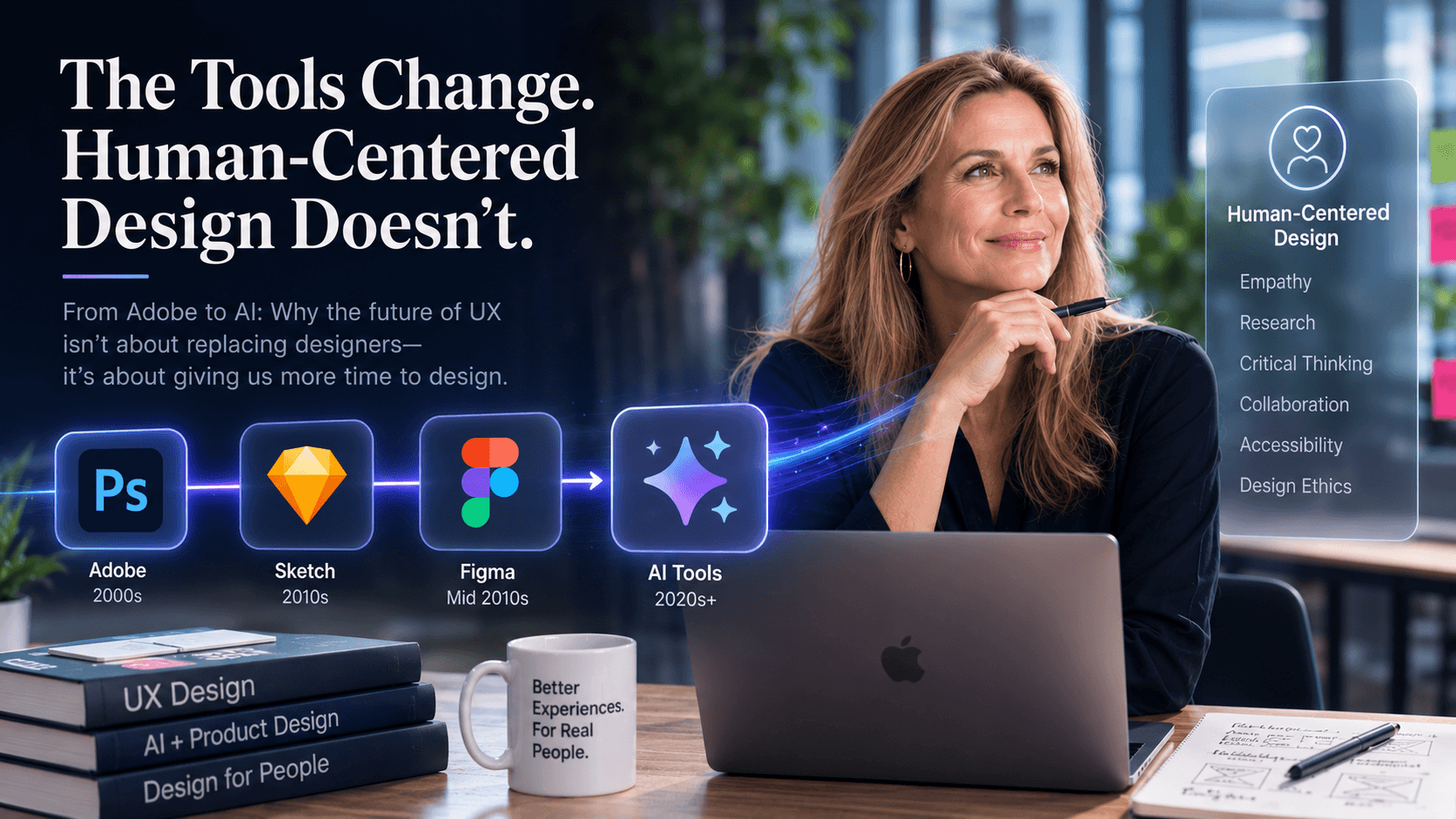
When I look back over my career, one thing has been constant. Every few years, the tools we use as designers change dramatically.
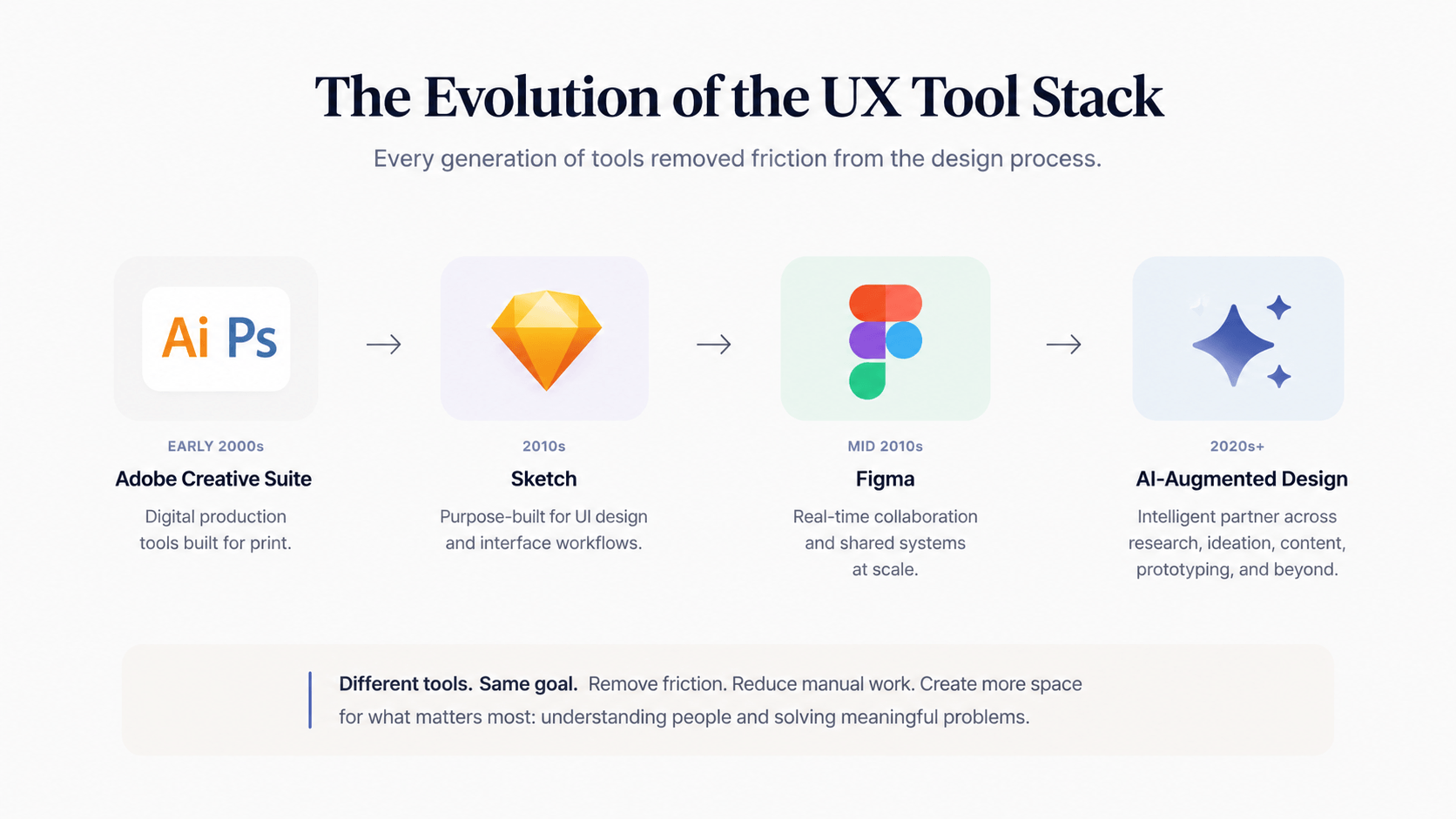
When I first started designing software, Adobe Photoshop, Illustrator, and Fireworks were the industry standard. We created static mockups, manually exported assets, and documented every interaction before handing designs off to engineering. It was a slower, more sequential process, but at the time it felt like the future of digital product design.
Then Sketch arrived and completely changed how interface designers worked. For the first time, we had software built specifically for designing digital products instead of adapting tools originally intended for print and graphic design. Reusable symbols and streamlined workflows meant we spent less time recreating the same elements and more time refining the experience itself.
Not long after that, Figma transformed the industry again. Design became collaborative instead of isolated. Product managers, engineers, researchers, and designers could all work together in the same file, making design feel less like a handoff and more like a continuous conversation. Design systems became central to how products were built, and collaboration became faster, more transparent, and significantly more productive.
At the time, each of these transitions felt disruptive. Every new tool required designers to learn new skills, rethink familiar workflows, and adapt to a different way of working. There was always uncertainty, and there were always debates about whether the latest platform was truly better than the previous one.
Looking back, however, those transitions tell a different story.
Each generation of tools removed friction from the design process. Adobe digitized production. Sketch streamlined interface design. Figma transformed collaboration. Every advancement made us a little more efficient and gave us something incredibly valuable: more time to focus on solving problems instead of wrestling with software.
That perspective has shaped how I think about the latest transformation our profession is experiencing.
Artificial intelligence is becoming part of the modern design workflow, and in my opinion, it is the biggest shift I have seen in my career. Unlike previous generations of software, AI is not simply another design application. It can help organize research, synthesize interviews, generate ideas, write UX copy, create prototypes, summarize documentation, and automate many of the repetitive tasks that have traditionally occupied a significant portion of a designer's week.
Rather than seeing AI as a replacement for designers, I see it as the next evolution of the tools we have always used to become better at our craft.
One of the biggest misconceptions about AI is that it is changing what designers do. From my perspective, it isn't.
What AI is changing is how we do it.
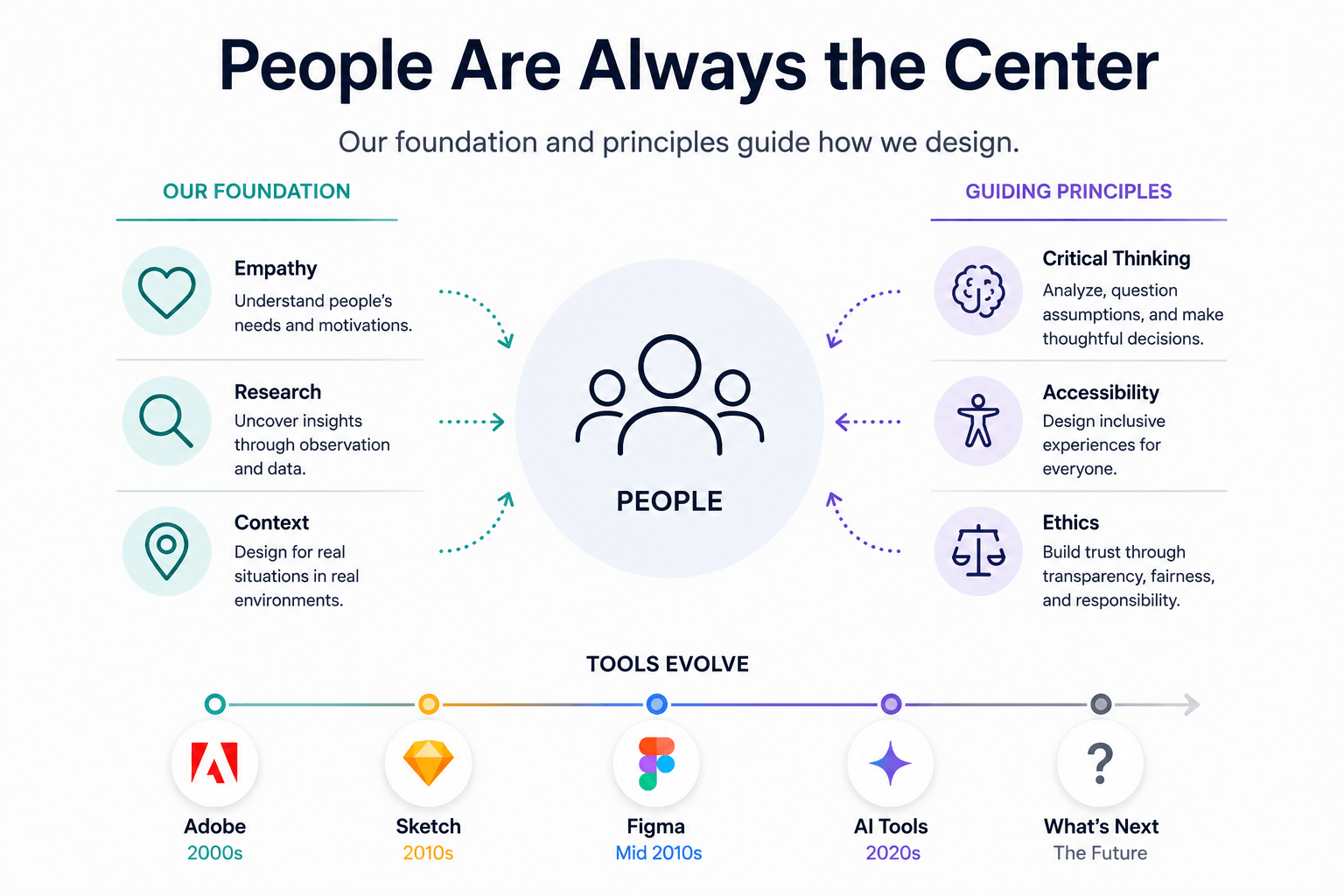
Throughout my career, the fundamentals of Human Centered Design have remained remarkably consistent. Every successful project still begins by understanding people. We conduct research to uncover goals, frustrations, motivations, and unmet needs before we ever begin thinking about screens or features. We ask questions, observe behavior, challenge assumptions, test ideas, and continuously learn from the people we are designing for.
None of that changes because AI exists.
What AI changes is the amount of manual effort required to move through the design process.
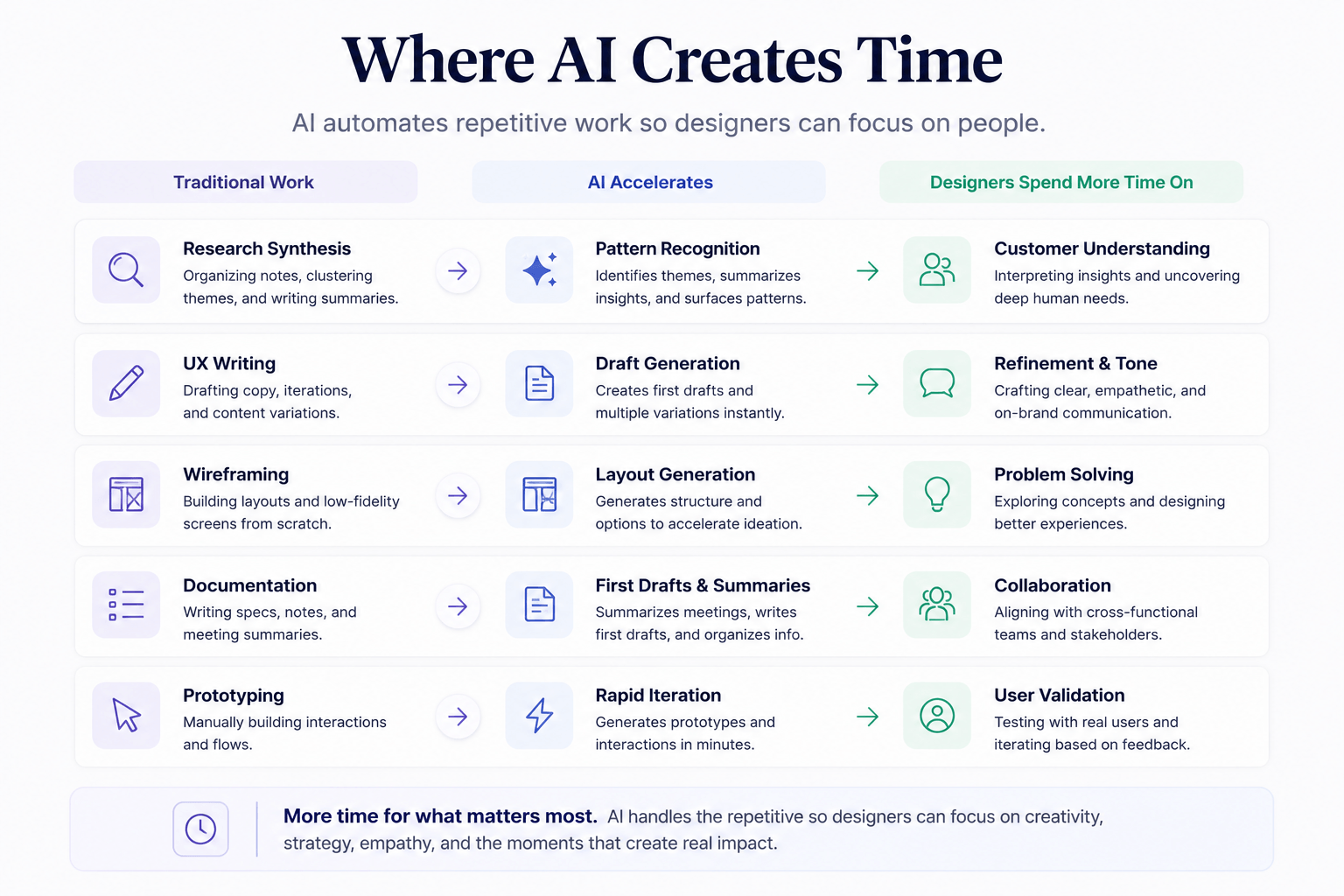
Research synthesis is a great example. Anyone who has facilitated customer interviews knows that the real work often begins after the interviews are over. Organizing notes, identifying themes, clustering insights, writing summaries, and translating findings into recommendations can take hours or even days. AI can now help accelerate much of that work, allowing designers to spend less time organizing information and more time interpreting what it actually means. Instead of manually sorting sticky notes or formatting research reports, we can focus on identifying opportunities, validating insights, and deciding what should happen next.
The same thing is happening throughout our workflow. AI can help generate first drafts of UX copy, create early wireframes, organize documentation, summarize meetings, and rapidly explore multiple design directions. These are all valuable activities, but they have never represented the true value of design. They are simply the work required to get to the interesting part.
For me, that is where AI becomes exciting.
It gives us something every design team wishes it had more of: time.
More time to spend with customers.
More time to validate ideas.
More time to collaborate with engineers and product managers.
More time to think.
More time to iterate.
More time to improve accessibility and refine experiences before they reach customers.
Those are the activities that have always produced better products. AI simply gives us more opportunities to invest in them.
As I have reflected on this shift, one idea has stayed with me.
Production is no longer scarce. Judgment is.
The more I think about that statement, the more true it feels.
Creating options has become remarkably easy. AI can generate dozens of interface concepts, summarize large amounts of research, draft UX copy, and create prototypes faster than any designer could have imagined just a few years ago.
Choosing the right direction, however, has not become any easier.
If anything, it has become harder.
When almost anyone can generate dozens of ideas, the real differentiator becomes knowing which ideas deserve to move forward. That is where experience still matters. Understanding customers, recognizing meaningful patterns, balancing business goals with user needs, and making thoughtful product decisions are still deeply human responsibilities.
AI can generate answers.
It still depends on us to ask better questions.
It can summarize research.
It cannot build empathy with the person sitting across the table.
It can generate interface concepts.
It cannot understand the emotional context behind a customer's experience.
It can recommend solutions.
It cannot replace the judgment that comes from years of observing people, testing ideas, and learning what creates meaningful outcomes.
That is why I believe Human Centered Design becomes even more valuable in an AI assisted world. As production work becomes faster and easier, our profession naturally shifts toward the activities that have always required uniquely human capabilities. We spend less time producing artifacts and more time understanding people, making sense of complexity, facilitating collaboration, and helping teams make better decisions.
When I think about the future of product design, I am optimistic.
Every major technology shift has challenged designers to adapt. I have watched our profession move from Adobe to Sketch, from Sketch to Figma, and now into an era of AI assisted design. Each transition changed the way we worked, but none of them changed the reason we do the work in the first place.
We are still here to understand people.
We are still here to simplify complexity.
We are still here to help organizations build products that solve real problems for real users.
That responsibility has not changed, and I do not believe it ever will.
As repetitive production work becomes increasingly automated, the qualities that define exceptional designers become even more valuable. Empathy, curiosity, critical thinking, collaboration, and good judgment are not becoming obsolete. They are becoming the skills that differentiate great designers from everyone else.
Five years from now, we will almost certainly be using tools that have not even been invented yet. That does not concern me because I have seen this cycle before. The software will continue to evolve, but the responsibility of designers remains remarkably consistent.
Great designers have never been defined by the software they use.
They have always been defined by how deeply they understand people.
That is why I do not believe AI marks the end of Human Centered Design.
I believe it reinforces why it matters.
By automating repetitive production work, AI gives us the opportunity to spend more time doing the work that has always created the greatest value: understanding people, solving meaningful problems, and helping organizations build products that genuinely improve lives.
The tools will continue to change.
Human Centered Design won't.
And I think that is an exciting future for our profession.